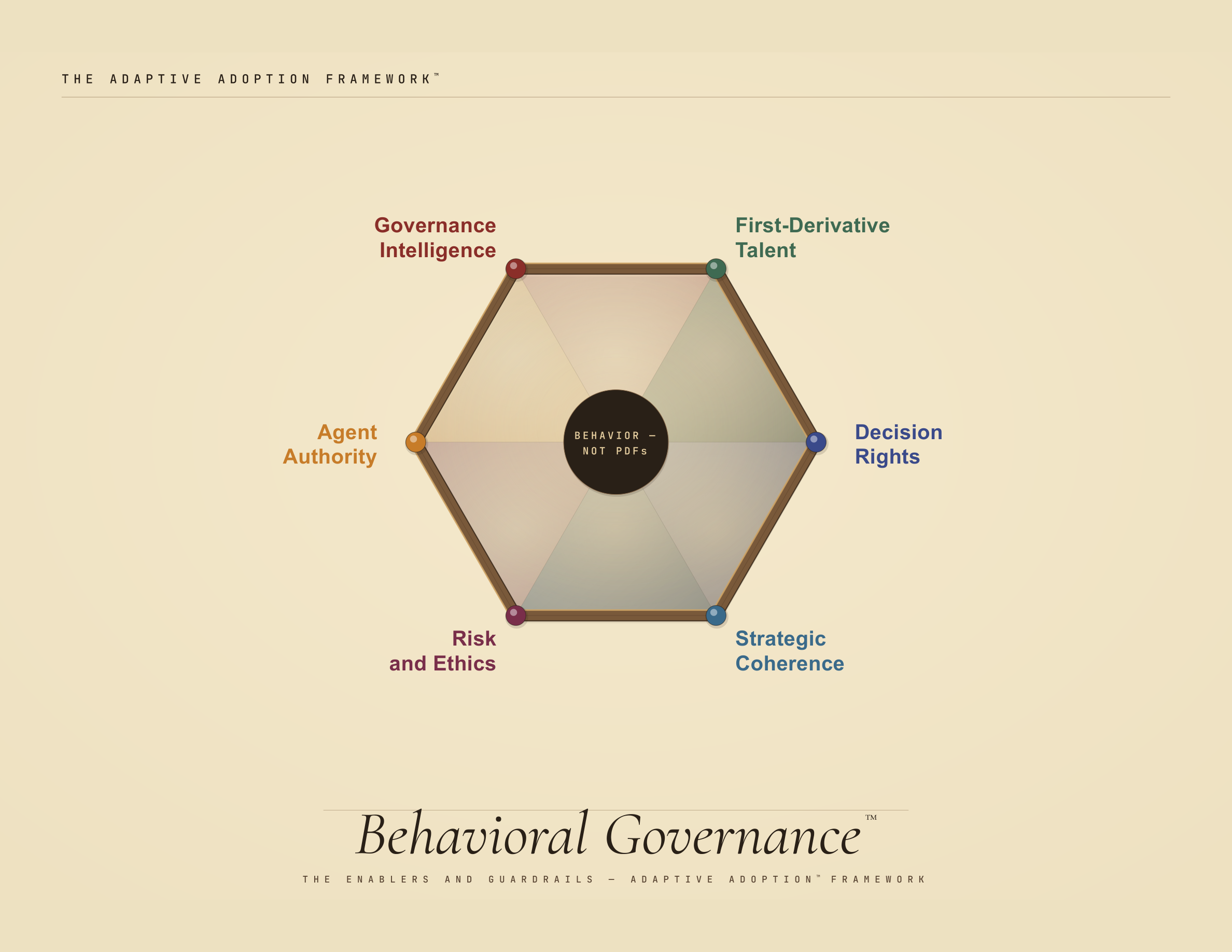
Behavioral Governance — The Guardrails

Discipline 3 of 3 · Six dimensions · How the organization governs AI use
Behavioral Governance replaces compliance-first governance with enacted governance — governance that lives in what people do, not what policies say. Every dimension is assessed via a three-layer protocol: Self-Report → Evidence → Behavioral Observation.
The distinction matters: organizations routinely score themselves as "governed" on self-report measures while exhibiting ungoverned behavior in practice. This discipline closes that gap.
The Six Dimensions
| # | Dimension | Focus |
|---|---|---|
| 1 | Decision Rights | Who decides what, with what authority, under what constraints |
| 2 | Agent Authority | How autonomous AI agents are authorized, bounded, and supervised |
| 3 | Risk Intelligence | Dynamic risk sensing, not static risk registers |
| 4 | Governance Intelligence | Board-level readout on AI governance maturity |
| 5 | 1st-Derivative Talent | The rate of capability change, not the snapshot |
| 6 | Strategic Coherence | Alignment between AI strategy, business strategy, and governance |
The Five Dials
Behavioral Governance tracks five organizational signals:
- Utilization Depth — How deeply AI is embedded in core workflows
- Capability Expansion Rate — The speed of skill acquisition
- Trust Stability — Whether trust in AI systems is calibrated or volatile
- Iteration Velocity — How fast the organization learns from AI deployments
- Leadership Delta — The gap between current and required leadership capability
Unique to This Discipline
- Dashboard — Board-level governance readout
- Tools — Risk register, audit templates, governance instruments
- Behaviors — Governance behavioral norms and standards
- Model Cards — Visual reference cards for each dimension
Three-Layer Assessment Protocol
Every dimension is assessed at three levels of evidence:
- Self-Report — What people say they do (surveys, interviews)
- Evidence — What artifacts and systems show (logs, documentation, audit trails)
- Behavioral Observation — What people actually do (observed practice, enacted behavior)
The gap between layers 1 and 3 is the governance maturity signal.
See 99_PROVENANCE.md for intellectual lineage.