Leadership Delta™ — The Torque
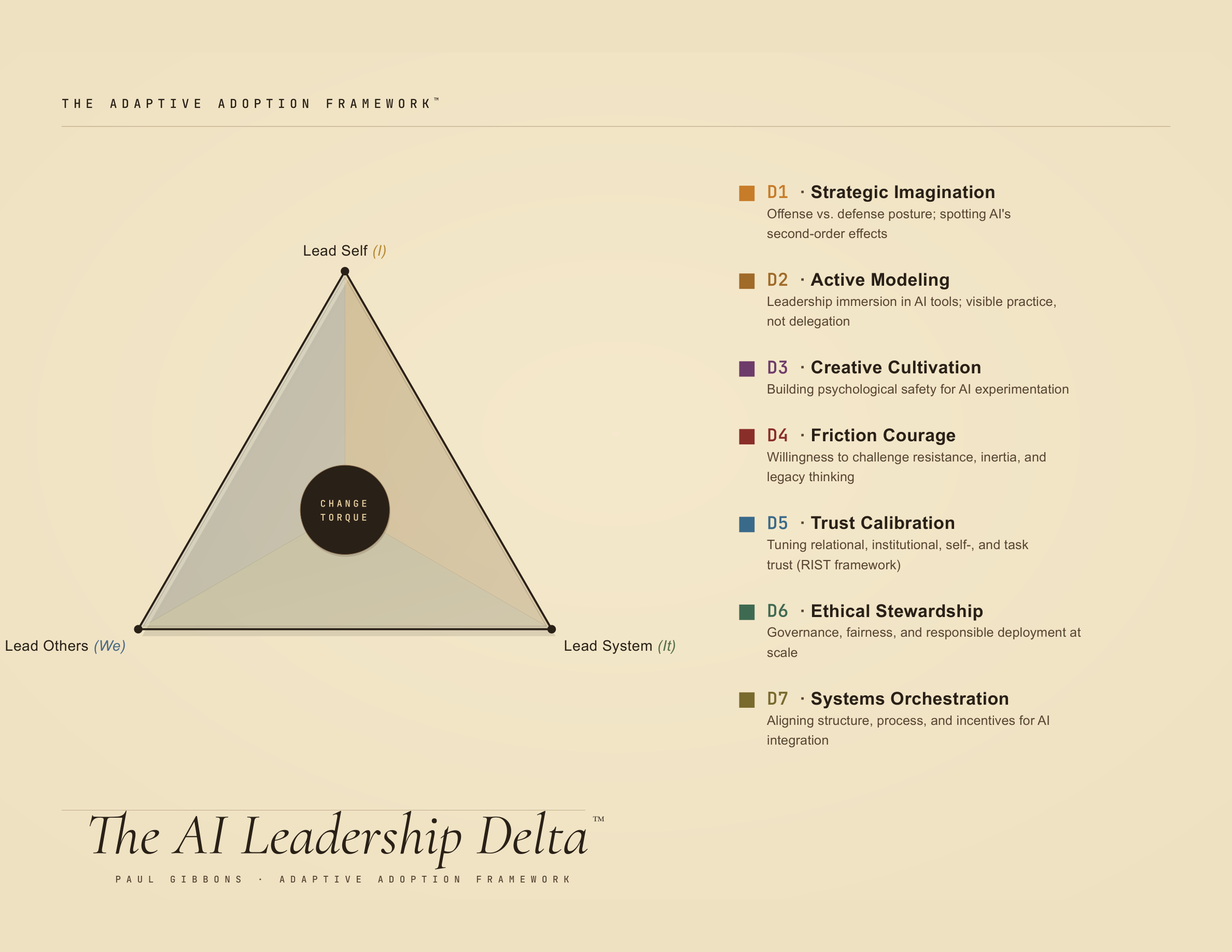
Synchronized from the canonical website on 2026-09-06.
Calling someone a sponsor doesn't make them a leader. Calling someone a change champion doesn't make them a leader. Leadership isn't boxes or titles.
Most AI leadership advice is old leadership theory with a fresh coat of AI paint. See if this is really different.
Explore the framework
| # | Pillar / dimension |
|---|---|
| 1 | Strategic Imagination |
| 2 | Active Modeling |
| 3 | Creative Cultivation |
| 4 | Friction Courage |
| 5 | Trust Calibration |
| 6 | Ethical Stewardship |
| 7 | Systems Orchestration |
The Specific Leadership Problems AI Generates
- Leaders can no longer govern from distance. If they do not use the tools themselves, they cannot judge what is real, what is possible, or what is dangerous — nor empathize with the frustrations teams are feeling, nor experience the potential viscerally.
- Judgment gets harder, not easier. AI produces fluent answers at speed; the leadership job is no longer confidence, but calibration.
- Strategy becomes unstable. Capabilities shift monthly, competitive advantage decays faster, and waiting is itself a strategic choice.
- Experimentation becomes leadership work. If leaders do not model learning in public, the organization retreats into caution, theater, or shadow AI.
- Expertise gets inverted. Leaders now depend on people below them for technical truth, while still carrying accountability at the top.
- Friction gets political. Legal, risk, IT, HR, and the business all pull differently; leaders must know which frictions to tear down and which are load-bearing.
- Trust becomes operational. Naming trust on a slide fixes nothing. Leaders must decide where trust should rise, where it should fall, and how to tell the difference.
- Ethical judgment becomes daily work. “Can we?” is easy. “Should we?” is now a Tuesday morning question.
Why Leadership Delta Is Different
- Not a search-and-replace job. This framework starts from the claim that AI changes leadership itself, not just the agenda around it.
- Behavioral, not decorative. It focuses on what leaders actually do: what they model, what they permit, what they challenge, and what systems they create.
- Not a virtue list in a nice font. “Be visionary,” “be curious,” and “be ethical” are too vague to help anyone lead.
- Trust is treated as a live variable, not a slogan. Naming trust does not fix trust; calibration does.
- Ethics is not outsourced. Legal and compliance matter, but they cannot carry the moral burden of AI for the enterprise. Leadership Delta treats ethical judgment as a daily leadership task, not a governance appendix.
- Open source, not consultancy theater. The argument, tools, diagnostics, and methods are inspectable, usable, and designed to improve in the open.
- Part of a larger system. Leadership Delta sits inside Adaptive Adoption alongside innovation and behavioral governance; it is not a lonely box diagram pretending to explain the world.
Tools, publications, and provenance
Older research notes and supporting drafts remain available in this directory. The numbered Markdown pages linked above carry the current website wording.